Dodecahedral Snyder Equal Area
Added in version 9.9.
Snyder's equal-area mapping [Snyder1992] applied to the twelve pentagonal faces of a regular dodecahedron and unfolded into a planar net.
The dodecahedron is subdivided into 12 × 10 = 120 right sub-triangles, and each sub-triangle is mapped independently using the area-preserving Snyder construction.
See Polyhedral Snyder Equal Area projections for the shared theory.
Classification |
Polyhedral, equal area |
Available forms |
Forward and inverse, spherical and ellipsoidal |
Defined area |
Global |
Alias |
dsea |
Domain |
2D |
Input type |
Geodetic coordinates |
Output type |
Projected coordinates |
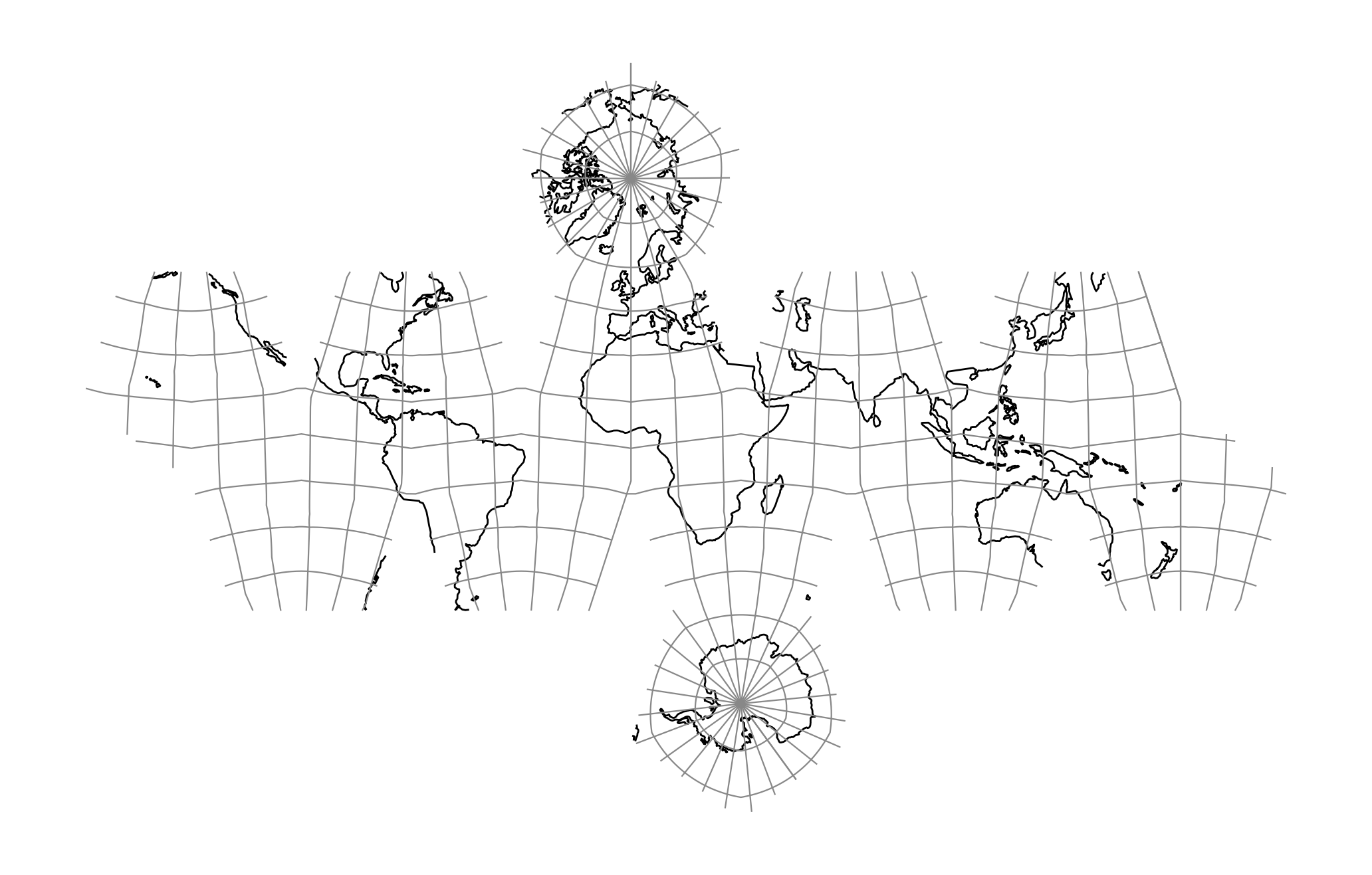
proj-string: +proj=dsea
Nets
The default net (shown above) follows Snyder's Figure 11. Three alternative
nets are available via +net=, and +dual unfolds the same mapping onto
the dual, icosahedral, net (equivalent to Icosahedral Vertex-oriented great circle Equal Area):
a5
Layout used by the A5 index. The first 8 faces contain the majority of the populated land mass.

proj-string: +proj=dsea +net=a5
crescent
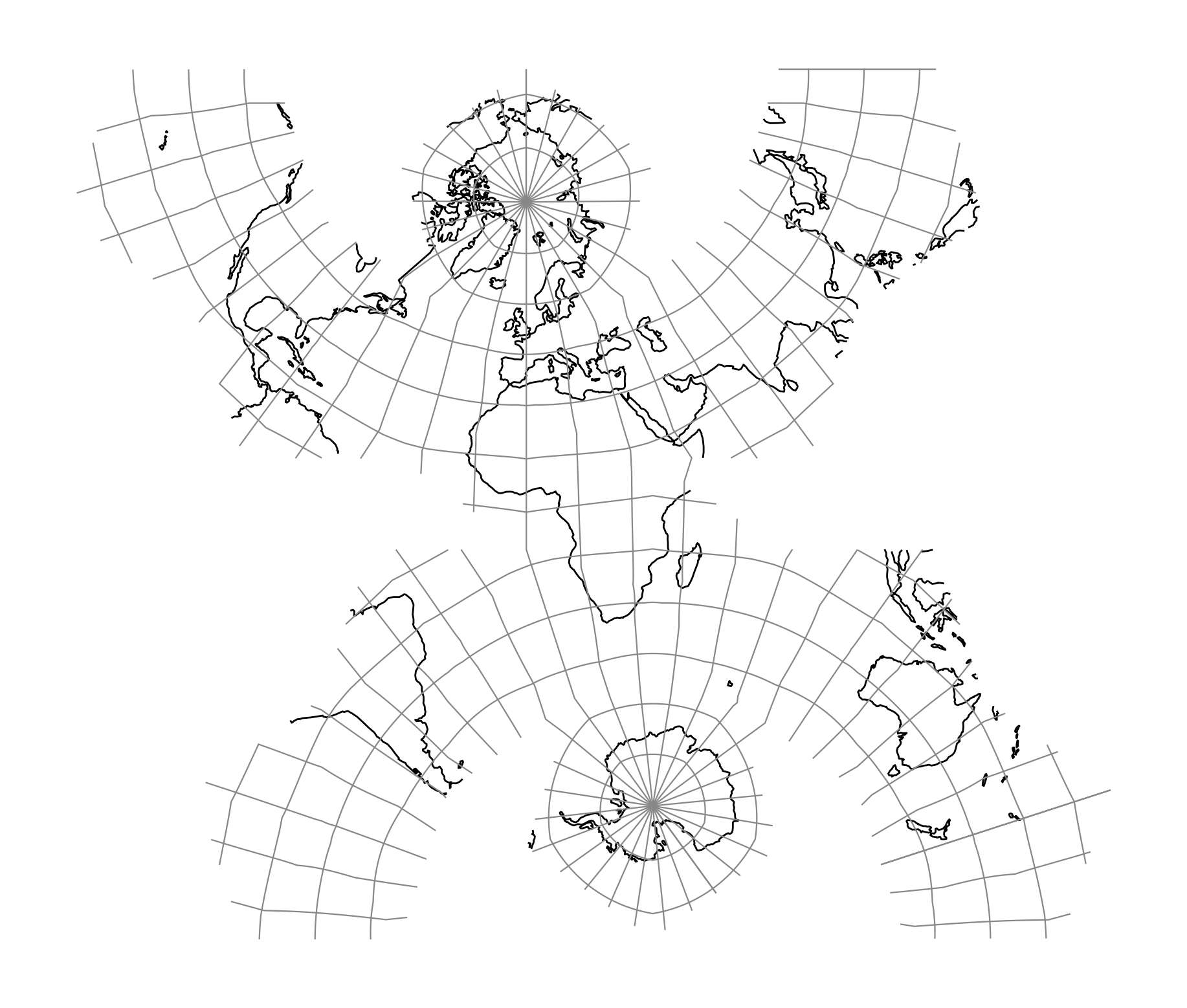
proj-string: +proj=dsea +net=crescent
flower
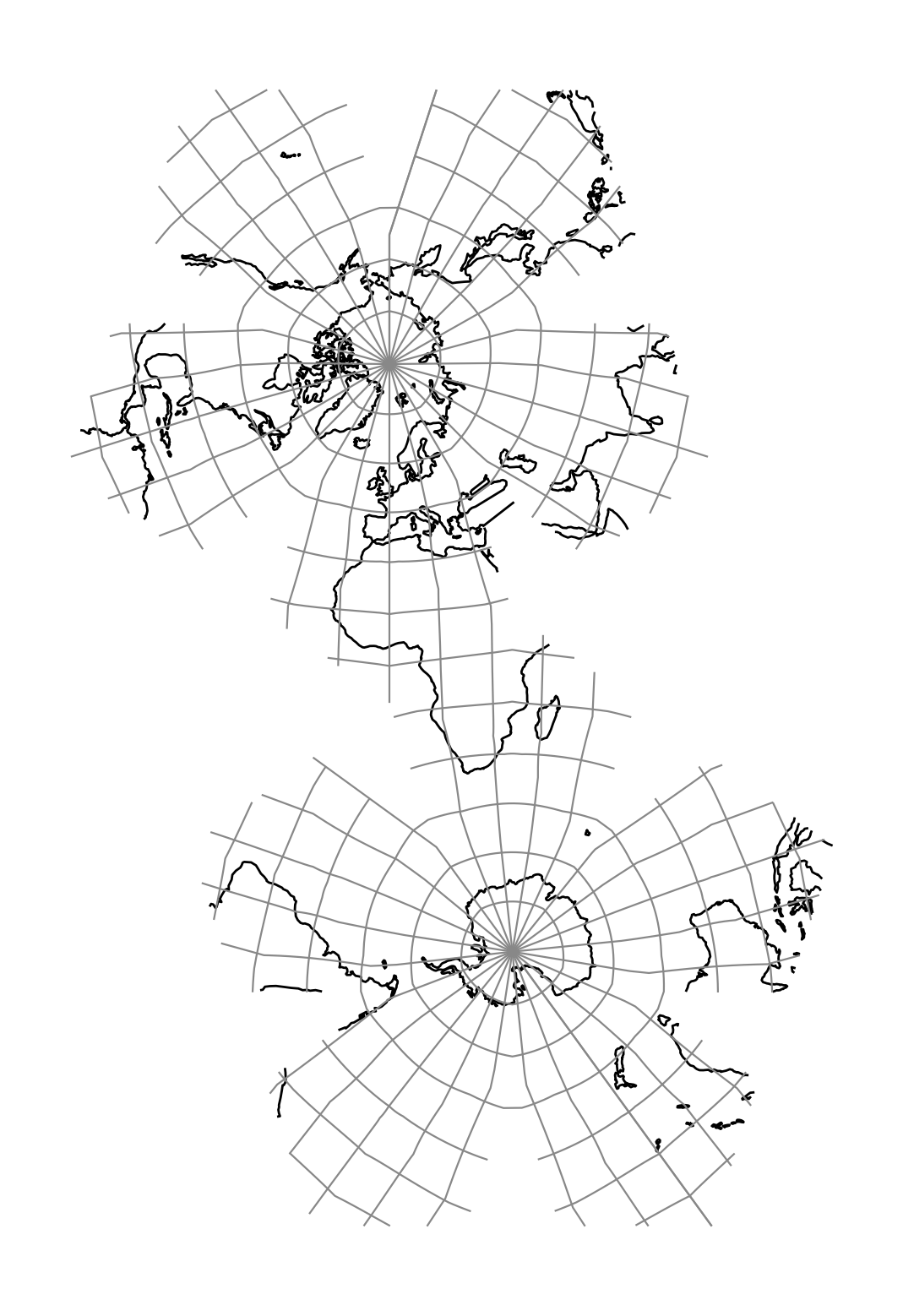
proj-string: +proj=dsea +net=flower
dual

proj-string: +proj=dsea +dual
Parameters
Note
All parameters are optional.
- +net=<name>
Selects the planar unfolding. Accepted values:
dsea,a5,crescent,flower.Defaults to
dsea.
- +dual
Unfolds onto dual icosahedron net. All options will be interpreted as if
+proj=iseawere specified. See also Icosahedral Vertex-oriented great circle Equal Area
- +orient_lat=<value>
Geodetic latitude of the polyhedron's first vertex, in degrees. Together with
+orient_lonand+azithis fully constrains the 3D pose of the polyhedron on the sphere.
Defaults to \(\arctan \frac{1 + 2\cos 36^\circ}{2} \approx 52.6226^\circ\).
- +orient_lon=<value>
Longitude of the polyhedron's first vertex, in degrees. Together with
+orient_latand+azithis fully constrains the 3D pose of the polyhedron on the sphere.
Defaults to −36.0 (or −129.0 when +net=a5 ).
- +azi=<value>
Azimuth from the polyhedron's first vertex to its second, in degrees clockwise. Together with
+orient_latand+orient_lonthis fully constrains the 3D pose of the polyhedron on the sphere.
Defaults to 240.0.
- +lat_0=<value>
Geodetic latitude of the geographic point that should land at the projected origin
(0, 0). Used together with+lon_0; the pair translates the projected output without rotating the polyhedron.+x_0/+y_0are applied on top of this translation.When unset, the projected origin falls on the unfold's root face instead (its centroid in general, or its bounding-box centre for
+proj=isea) rather than at a fixed lat / lon.Note
The default convention is to interpret this value as decimal degrees. To specify radians instead, follow the value with the "r" character.
Example: +lat_0=1.570796r
See Projection Units for more information.
- +lon_0=<value>
Geodetic longitude of the geographic point that should land at the projected origin
(0, 0). Used together with+lat_0; the pair translates the projected output without rotating the polyhedron.+x_0/+y_0are applied on top of this translation.When unset, the projected origin falls on the unfold's root face instead (its centroid in general, or its bounding-box centre for
+proj=isea) rather than at a fixed lat / lon.Note
The default convention is to interpret this value as decimal degrees. To specify radians instead, follow the value with the "r" character.
Example: +lon_0=1.570796r
See Projection Units for more information.
- +x_0=<value>
False easting, easting at false origin or easting at projection centre (naming and meaning depend on the projection method). Always in meters.
Defaults to 0.0.
- +y_0=<value>
False northing, northing at false origin or northing at projection centre (naming and meaning depend on the projection method). Always in meters.
Defaults to 0.0.
- +ellps=<value>
The name of a built-in ellipsoid definition.
See Ellipsoids for more information, or execute
proj -lefor a list of built-in ellipsoid names.Defaults to "GRS80".
- +R=<value>
Radius of the sphere, given in meters. If used in conjunction with
+ellps,+Rtakes precedence.See Ellipsoid size parameters for more information.